The Ring came down for two reasons: privacy and performance. Replacing it properly took two halves — the doorbell, which is a button, a chime and a notification, and the camera, which is a hardwired UniFi G6 Bullet at the front door. Neither half replaces a Ring on its own. This post covers the doorbell; the camera comes in as part of wiring the house for networking.
What went up in the Ring’s place is a plain mechanical button on the same wiring that was already run to the front door, with everything clever moved into a junction box next to the chime.
How it works
The existing transformer still supplies 16 V AC. From there:
- An AC/DC converter turns the 16 V AC into 12 V DC.
- The 12 V DC powers both the chime and a Shelly 1 Gen4.
- The button at the door pulls the Shelly’s
SWinput to ground. - The Shelly closes its relay for 0.25 seconds, which rings the chime.
- The Shelly reports the press to Home Assistant, which pushes a notification to my phone.
The chime is no longer wired to the button at all. The button only talks to the Shelly, and the Shelly decides whether and how long the chime rings. That separation is what makes the rest of it possible.
Wiring
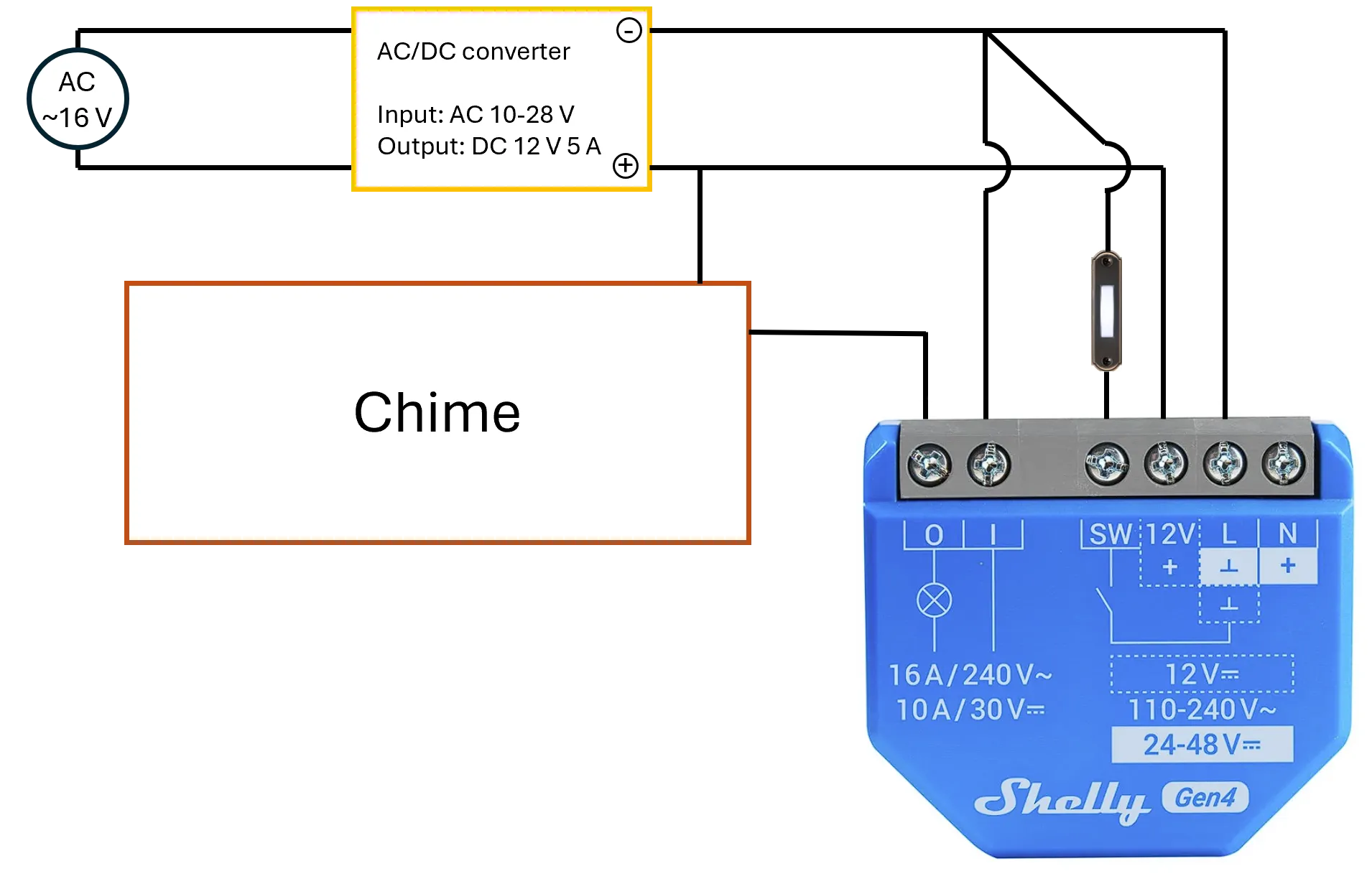
The Shelly 1 Gen4 has potential-free O and I contacts, so the chime circuit
is completely separate from the logic. Terminal by terminal:
| Terminal | Connects to | Why |
|---|---|---|
12V |
Converter + | DC positive goes here, not to N |
L (⊥) |
Converter − | DC ground |
SW |
Button → − | Button pulls SW to ground |
O |
Chime → + | One side of the dry contact |
I |
Converter − | Other side, completing the chime circuit |
The one worth writing down: on 12 V DC the positive goes to the 12V
terminal, not to N. The N terminal is marked +, which makes it the
obvious-looking choice and the wrong one — that marking is for the 24–48 V DC and
mains configurations. Ground goes to L, which is marked ⊥.
The 0.25 second pulse
The Shelly is configured to close its relay for 250 ms and then release, regardless of how long the button is held. Holding the button down does nothing. Pressing it thirty times in a row still produces thirty distinct, finite chimes.
That was the point — the doorbell cannot be held down — but it turned out to matter electrically too.
Why the short pulse matters more than I planned
A mechanical chime’s solenoid is designed for 16 V AC. On AC, the coil’s impedance is dominated by inductive reactance. On DC there is no reactance, so only the coil’s resistance limits current — which means 12 V DC can draw noticeably more current through that coil than 16 V AC does, despite being the lower voltage. A coil energised continuously on DC gets hot, and a stuck solenoid or melted sleeve is the usual way these fail.
At a 250 ms duty cycle this is a non-issue; there is nothing like enough time to heat the coil. But it does mean the timer matters. Worth remembering before changing that setting, or if the relay is ever suspected of sticking closed.
The strike itself is unaffected — the plunger throws on energise and returns on release, so it still gives a proper two-note ding-dong.
Mounting
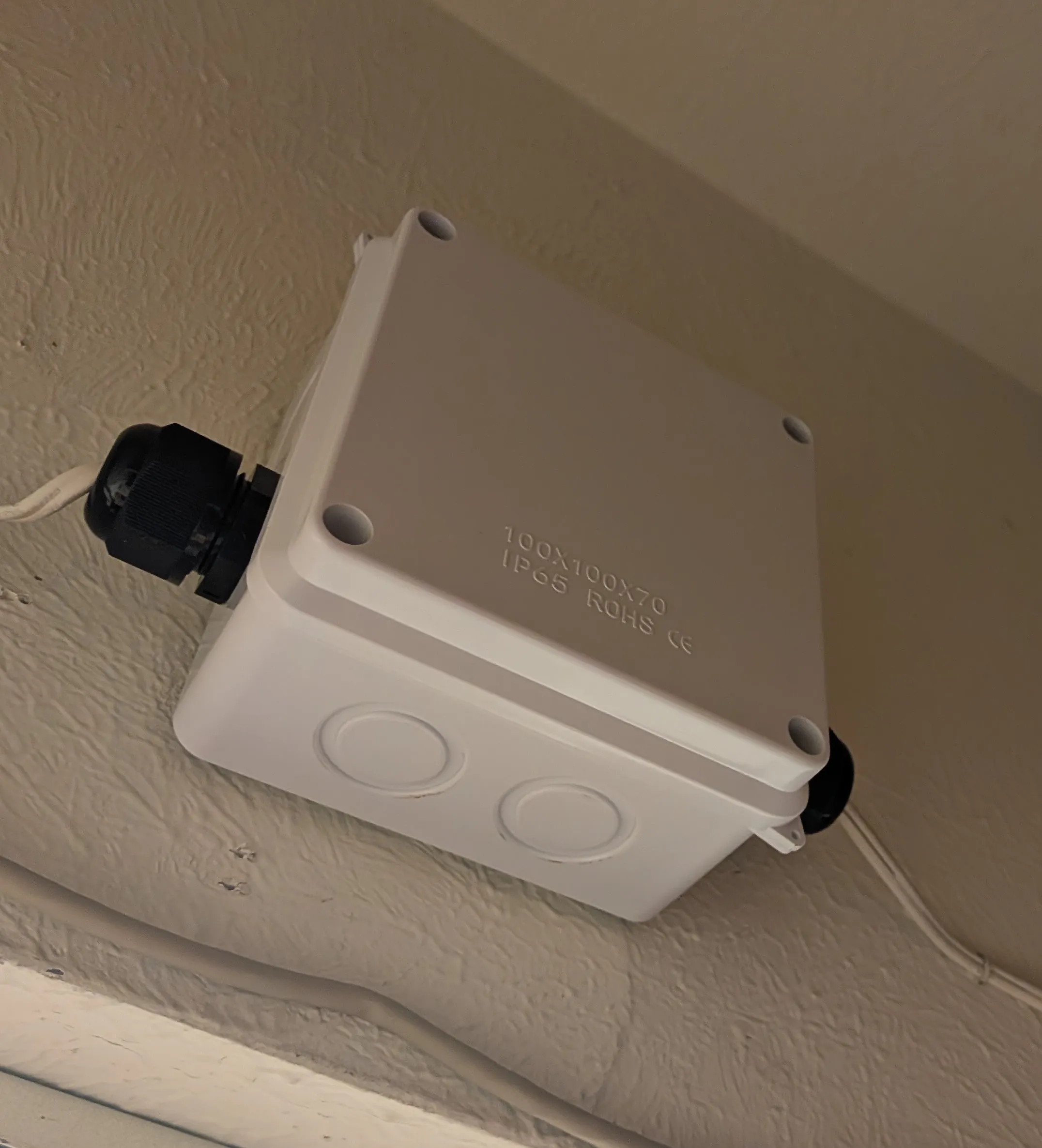
Converter, Shelly, and the Wago connectors all went into a surface-mount IP65 junction box, with glands on the cable entries.
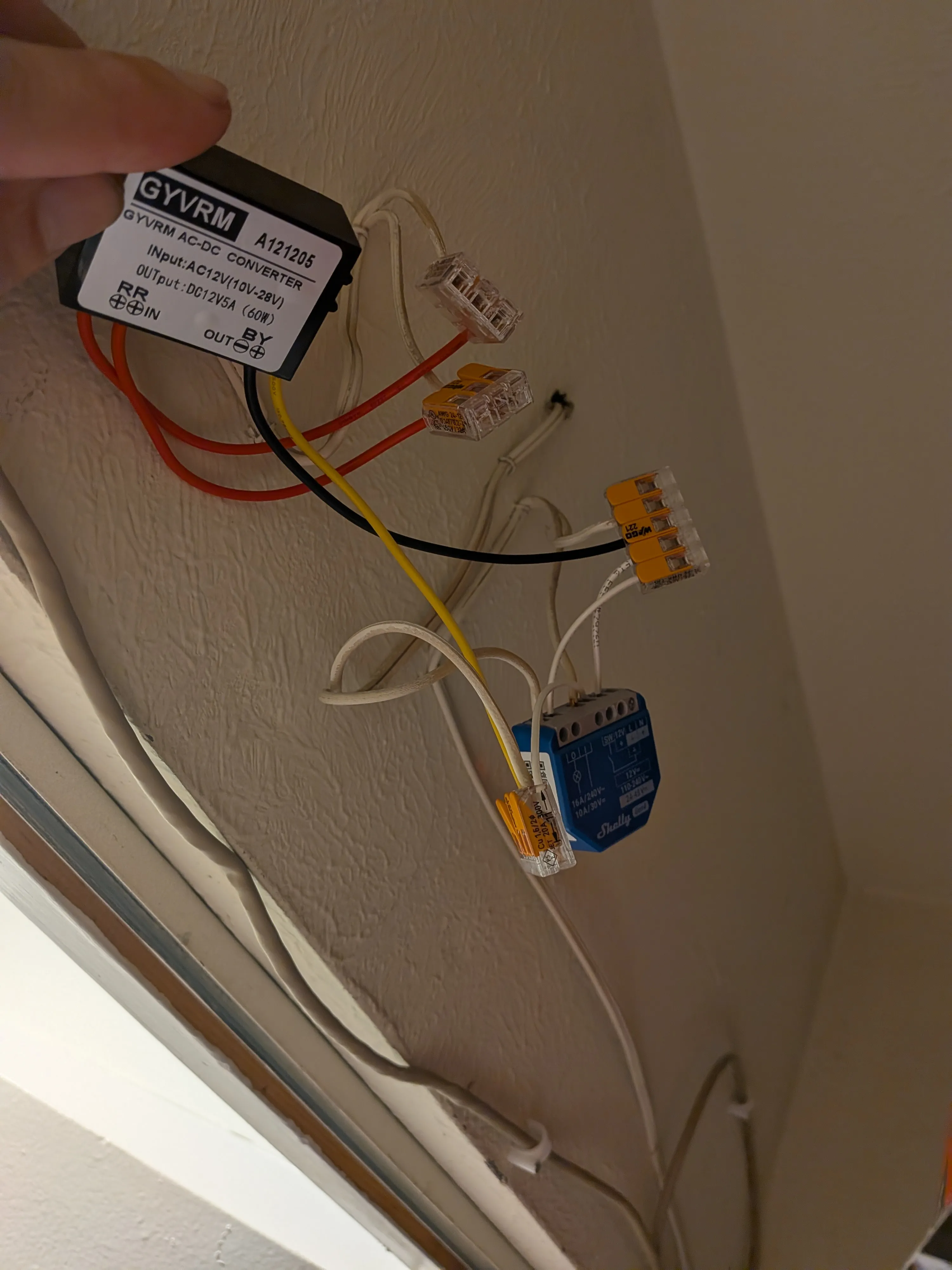
Three runs leave the box, one per direction:
| Direction | Goes to |
|---|---|
| Left | The low-voltage AC transformer |
| Right | The doorbell button |
| Up | The chime |
What is next
The other half of the replacement: a hardwired UniFi G6 Bullet covering the front door. Without it this is a doorbell, not a Ring replacement — the camera is the part that actually does what the Ring was doing. Its cable run is one of the four described in wiring the house for networking.
What I would do differently
Nothing, which is rare for me. It has worked as intended since it went in, and I have not had to change a setting or reopen the box.