Hungarian Rounds, grown in coco, drain to waste, in a tent in the basement. The peppers came from a pepper farmer on the California coast near San Francisco.
The point of the build was to get the routine down to two jobs: mix a nutrient solution about once a week, and do any training or pruning the plant needs. Everything else runs without me.
No harvest yet. This is a grow in progress.
The tent
A 3 ft × 3 ft × 6 ft Spider Farmer tent, with their GGS smart controller running the light, the circulation fan and the exhaust fan.
| Setting | |
|---|---|
| Light | 300 W full spectrum LED with far red emitters |
| Light level | 35%, 6–8 in above the canopy, PPFD ~500 |
| Photoperiod | 18 h — on at 11 PM, off at 5 PM |
| Circulation fan | Max, 24/7 |
| Humidity setpoint | 72% day, 65% night |
The photoperiod is shaped around electricity pricing, not the plant. Lights out at 5 PM keeps the tent off through my utility’s 5–9 PM time-of-use window.
In practice through the summer that lands at about 78 °F and a VPD around 0.9 during the day.
35% looks low, but it puts me at a DLI of 30–35 across the 18 hours. At that level more intensity would not add anything for this crop, so the light stays where it is and the canopy is what I work on instead.
What Home Assistant runs
Everything switched runs off a single Kasa smart power strip, joined over Matter and integrated through the Kasa integration. It has never been connected to the internet, which keeps it from pulling firmware updates.
Hanging off it:
- The fertigation pump
- The runoff pump
- A 500 W PTC heater on the tent floor
- A humidifier outlet
The last two are wired up and programmed but have not been needed this grow. A SwitchBot remote temperature, humidity and CO₂ sensor in the tent is the thermostat for the heater and the humidistat for the humidifier when either is in use.
Two leak sensors sit in the system: one on the floor of the tent, inside its watertight basin, and one in the runoff container. Either one triggering shuts fertigation off, and fertigation resumes on its normal schedule once they dry — which happens when I clean up the flood. The point is a trip or a longer time away: a small leak should stop the pump rather than run unattended for a week.
Fertigation
The reservoir is two 27-gallon Home Depot totes, nested. They were the only reasonably priced large-volume container I could find, and nesting two means that if the inner one cracks the outer one is secondary containment.
A roughly 30 W aquarium/fountain pump pushes solution through a tube with about half a dozen emitters spaced evenly around a 10-gallon fabric pot of coco. The pot is deliberately oversized — I intend to grow this plant as long as it will keep going, so I scaled up at the start rather than potting up later.
It runs every other morning as five short feeds of about ten seconds each, a minute apart. The gaps give each dose time to soak in, so the solution wets the whole medium instead of channeling straight through it.
Two Zigbee capacitive moisture sensors report the coco’s moisture to Home Assistant. The rule is not to let it fall more than 10–15% between feeds. At the current plant size and pot volume, every other day clears that comfortably. As the plant grows and drinks more, the frequency will go up.
Runoff
Water drains through the coco into a catch pan I built from scrap lumber and polyethylene sheet, which channels it out of a small spout on one side. From there it drops into a 3D printed sump holding a small 3 W aquarium pump.
That pump is on the smart strip too, and runs for about thirty minutes, pausing one second every thirty. The pump will not self-prime while it is running, but it primes reliably on a stop and restart, so a one second break every half minute keeps it going even when it pulls air.
It pushes the runoff into a smaller plastic container outside the tent, where I can measure it. I track EC and pH on both sides — what goes in, and what comes back out.
Training the canopy
Since canopy width is the lever, most of the hands-on time goes into low stress training: tying branches down to the rim of the pot with flexible silicone-coated wire, and guiding them out under the net to spread the footprint. A broader canopy captures more photons, which means more fruit.
Progress
It was slow to start. The coco was reused, and it took a few feedings before pH and EC settled somewhere the plant was happy with. Once it did, it took off.
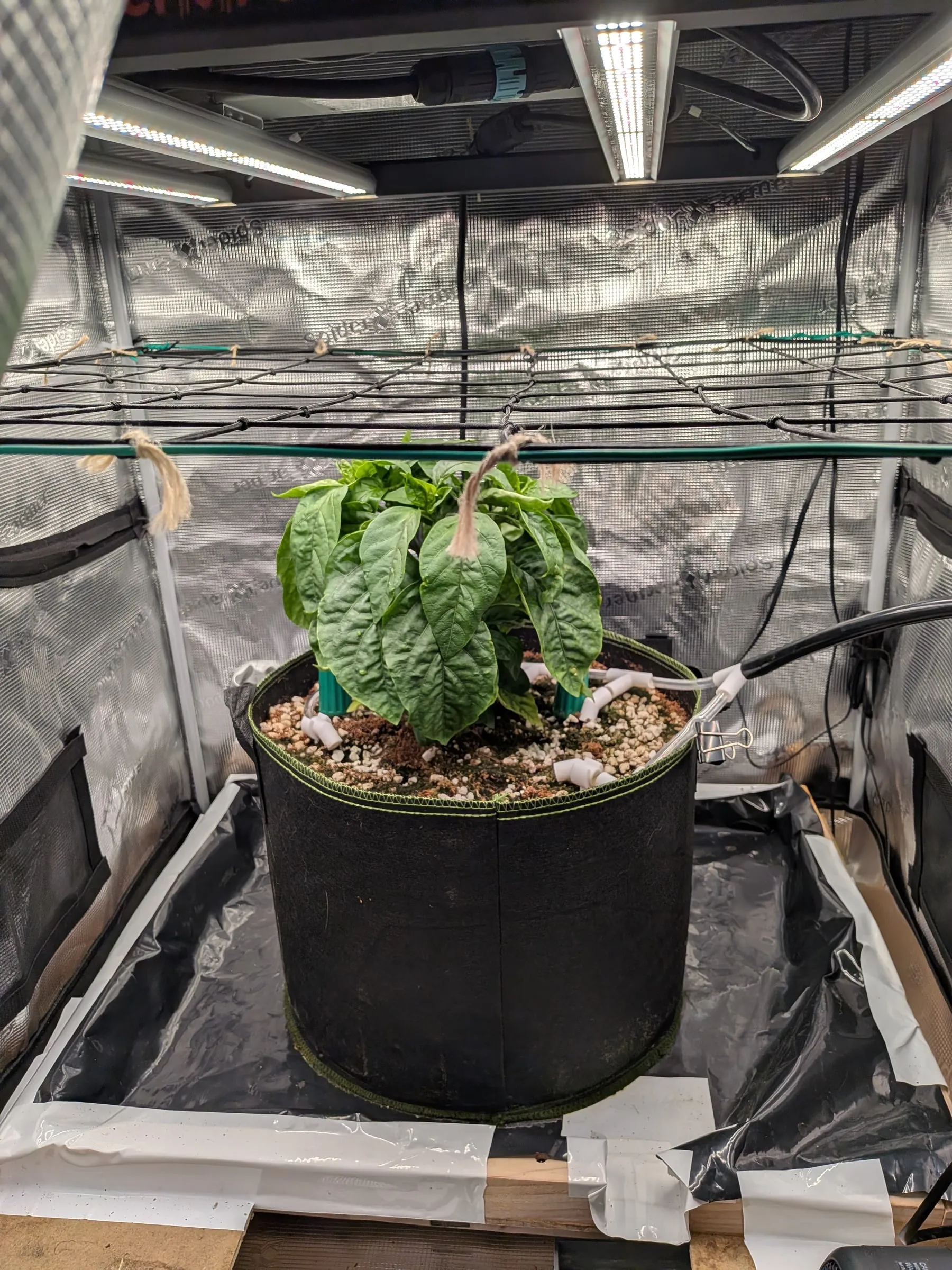
8 August — side profile early in the grow
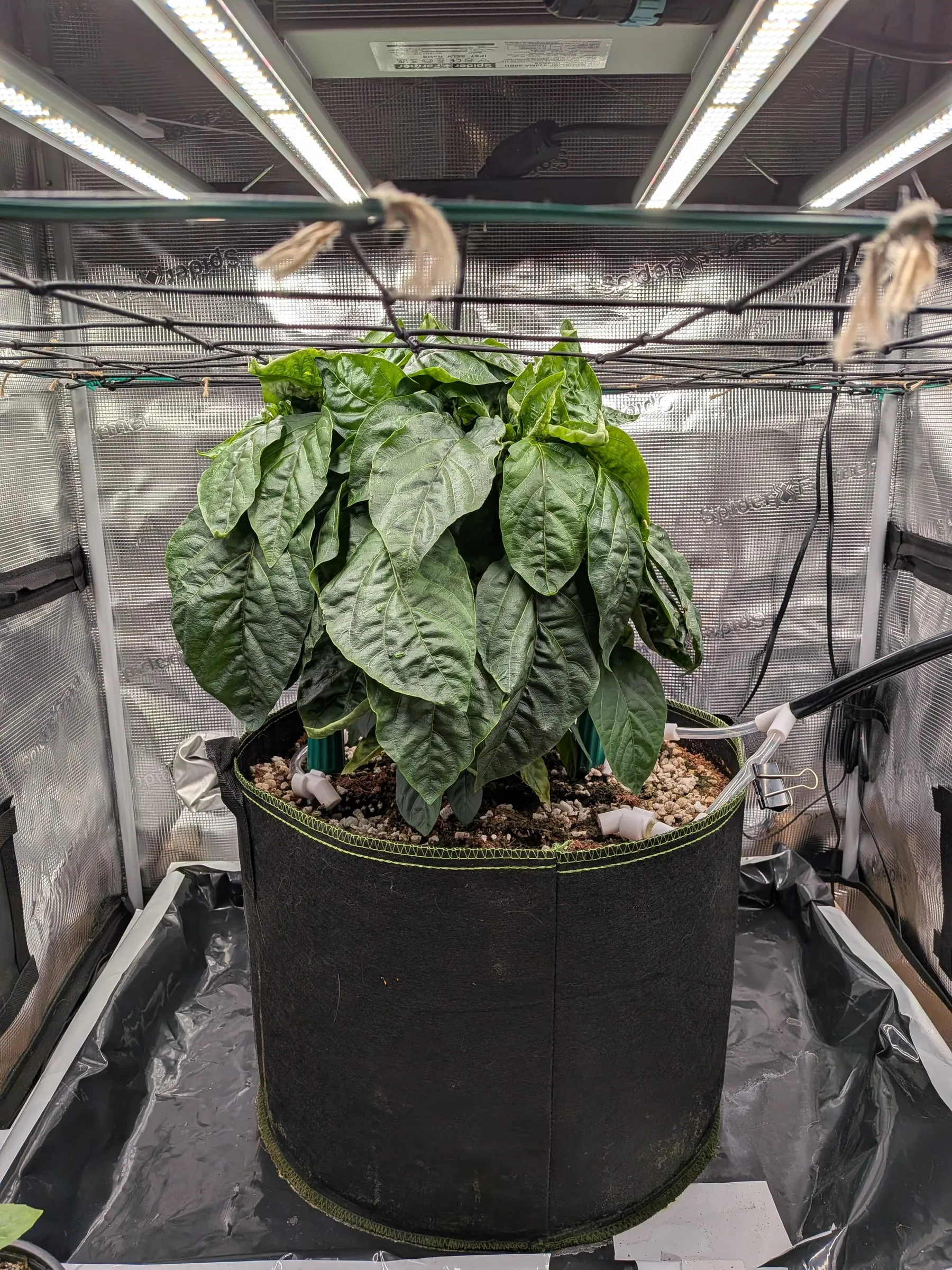
16 August — eight days on, rapid growth, and more of the tent systems visible
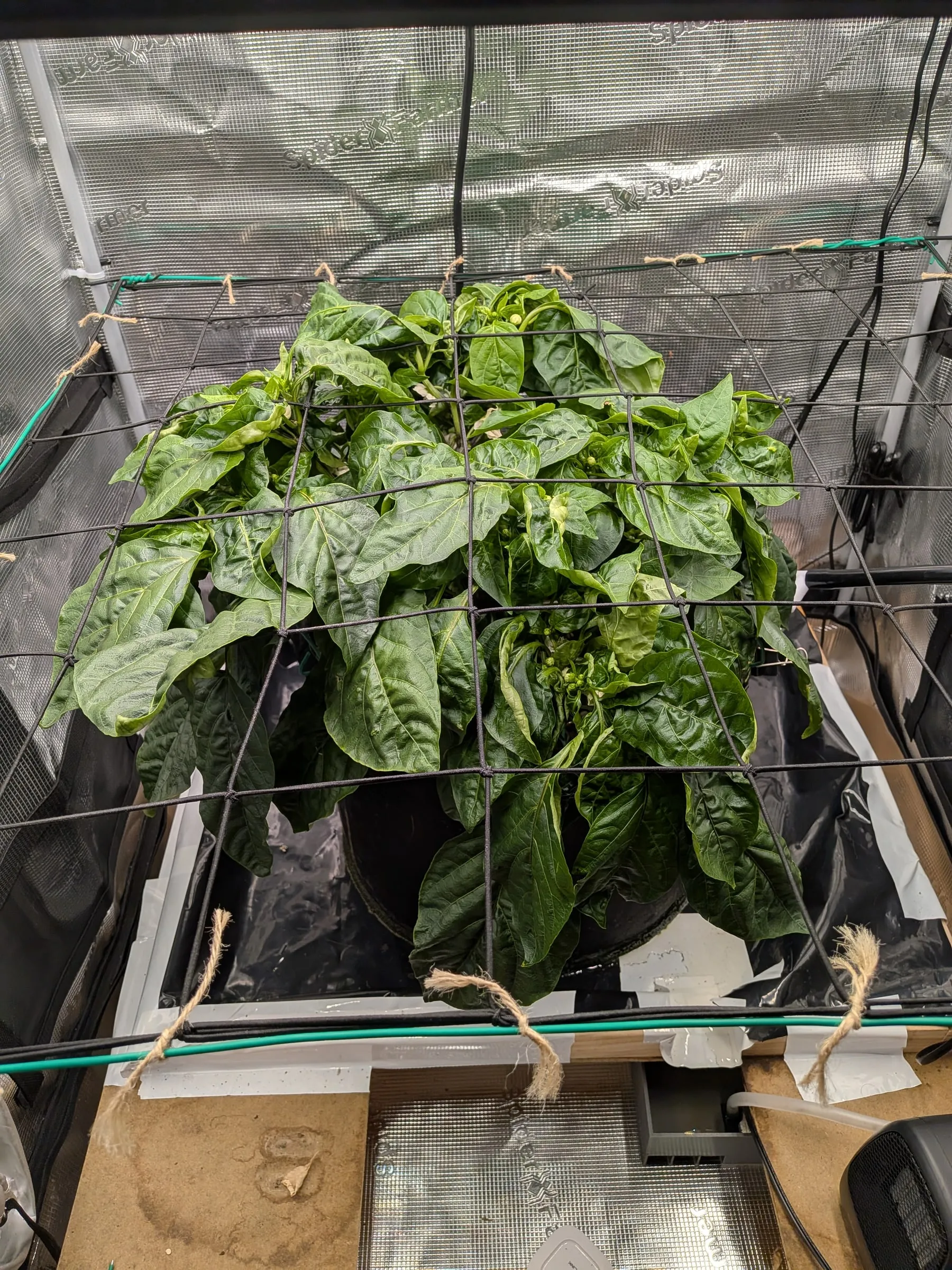
24 August — diagonal view down onto the canopy
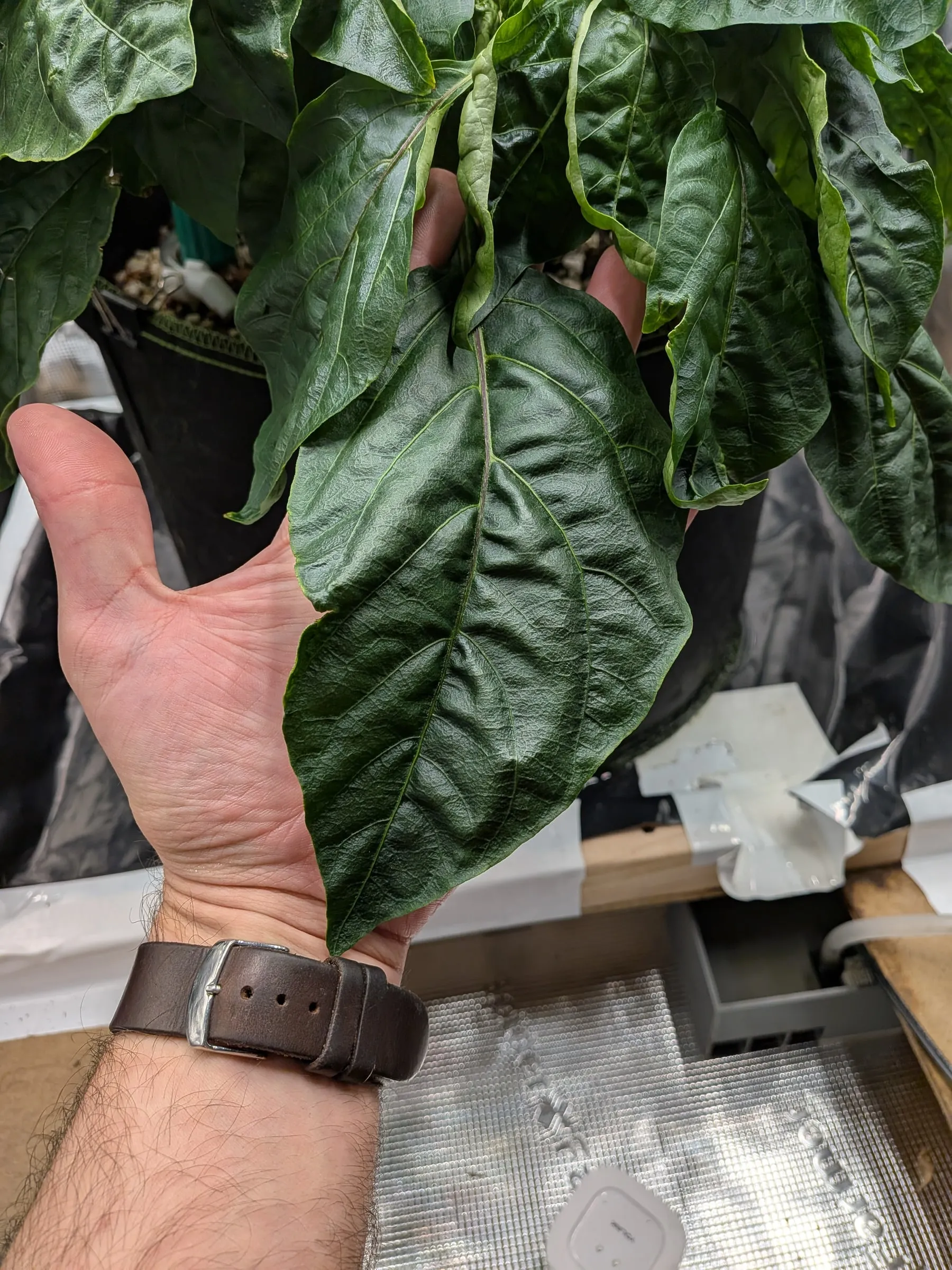
24 August — a single leaf, as wide as my hand
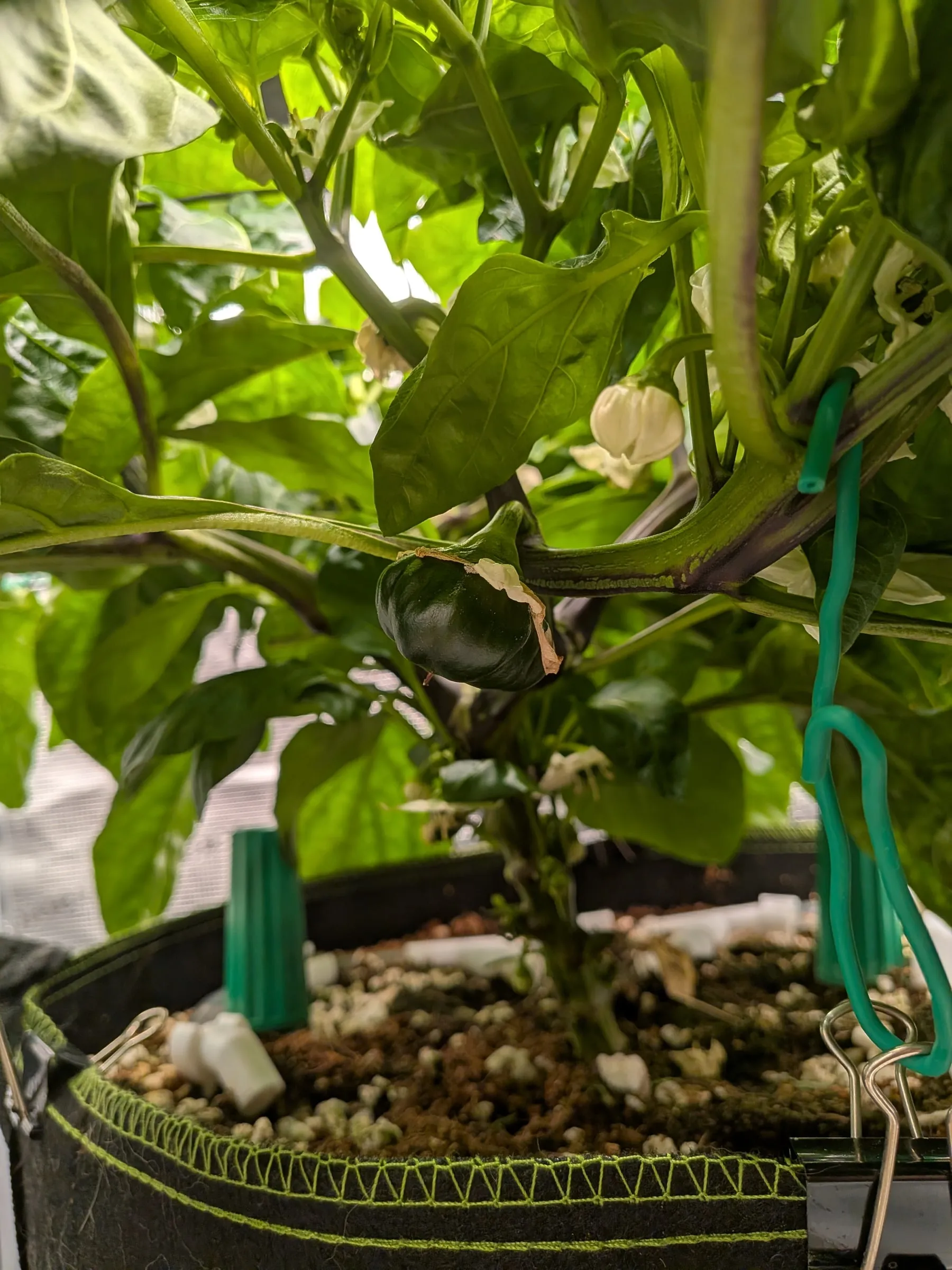
24 August — under the canopy, early fruit set
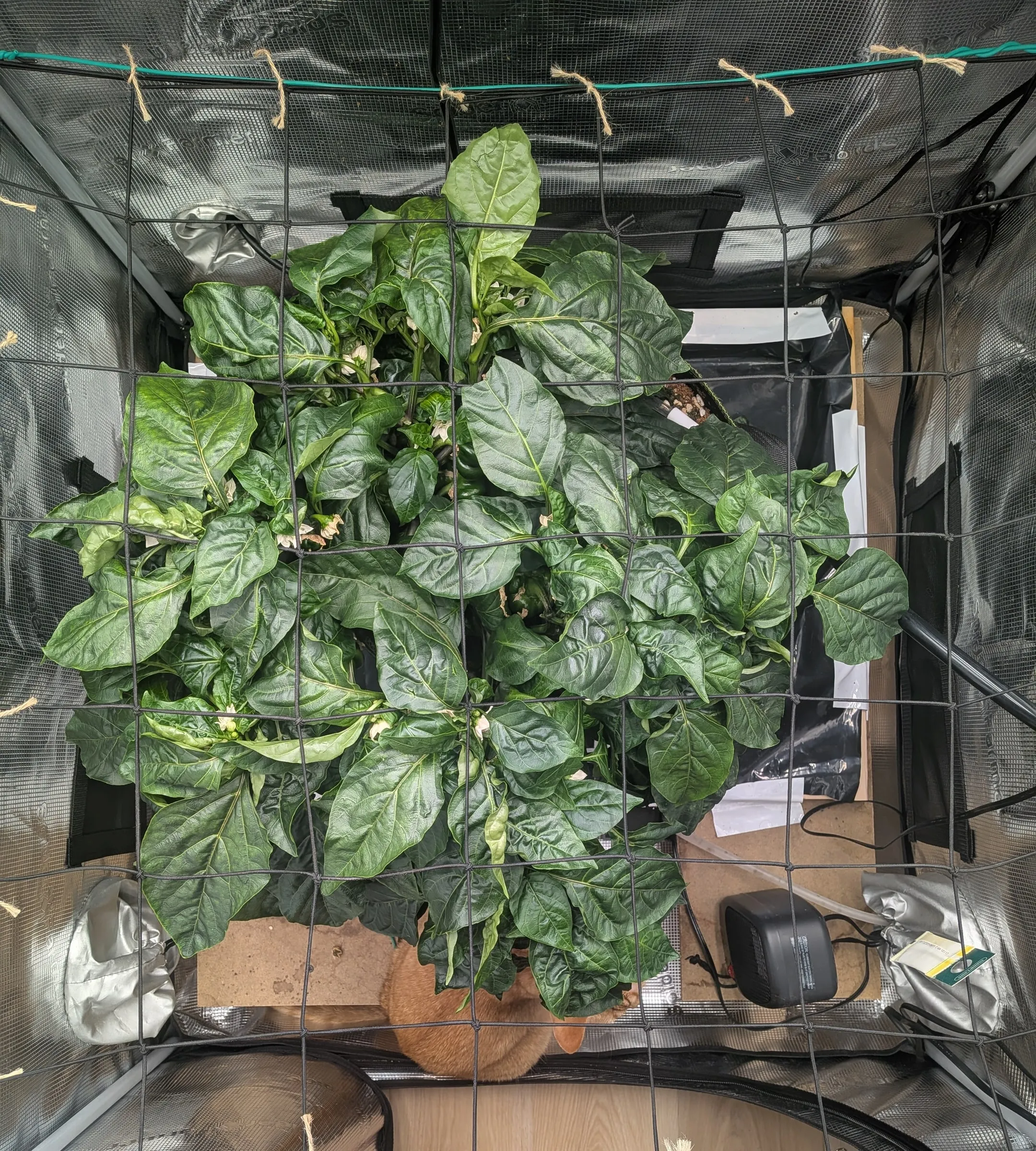
31 August — top down, against the 3×3 net for scale
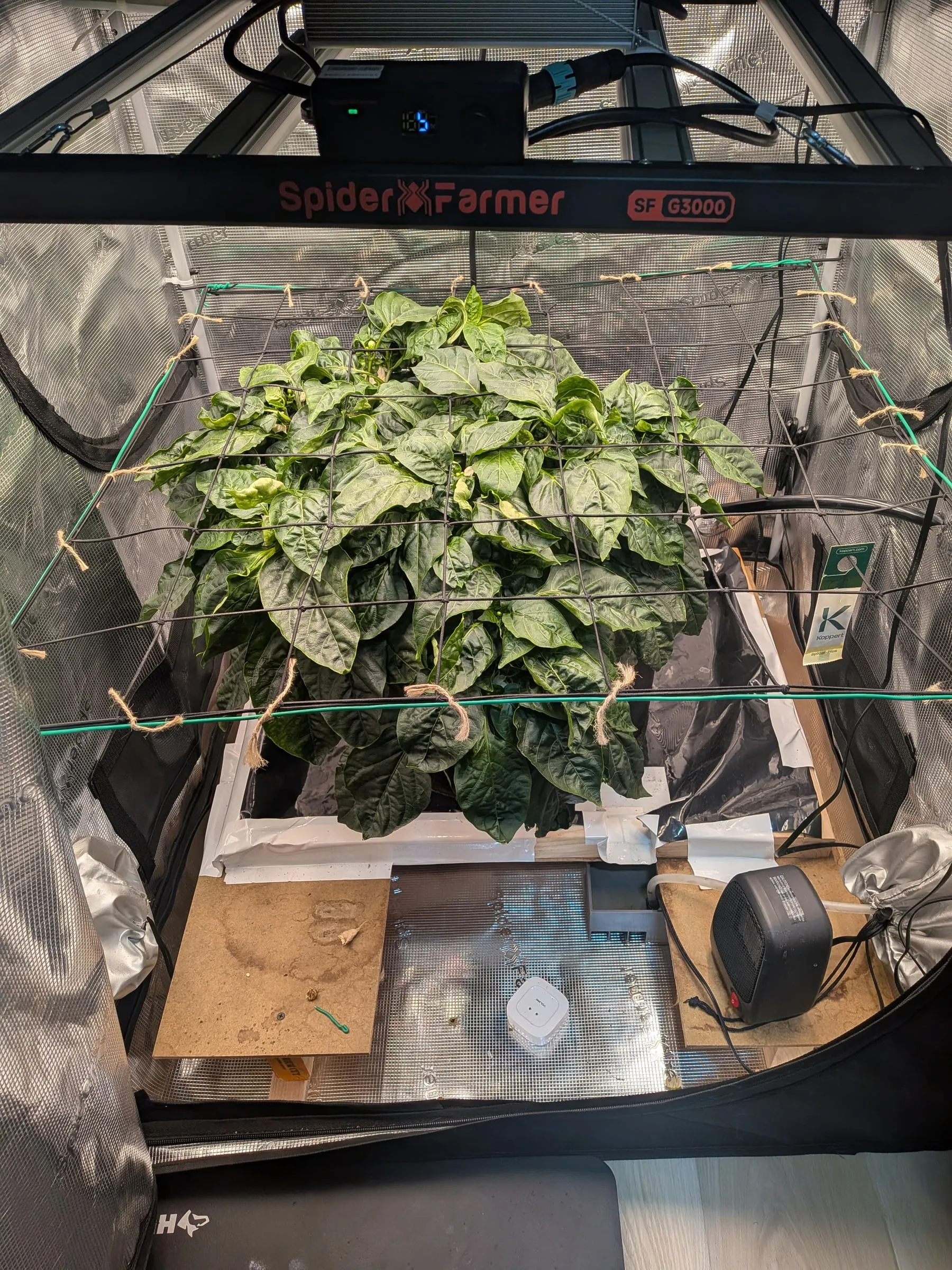
2 September — diagonal view into the canopy
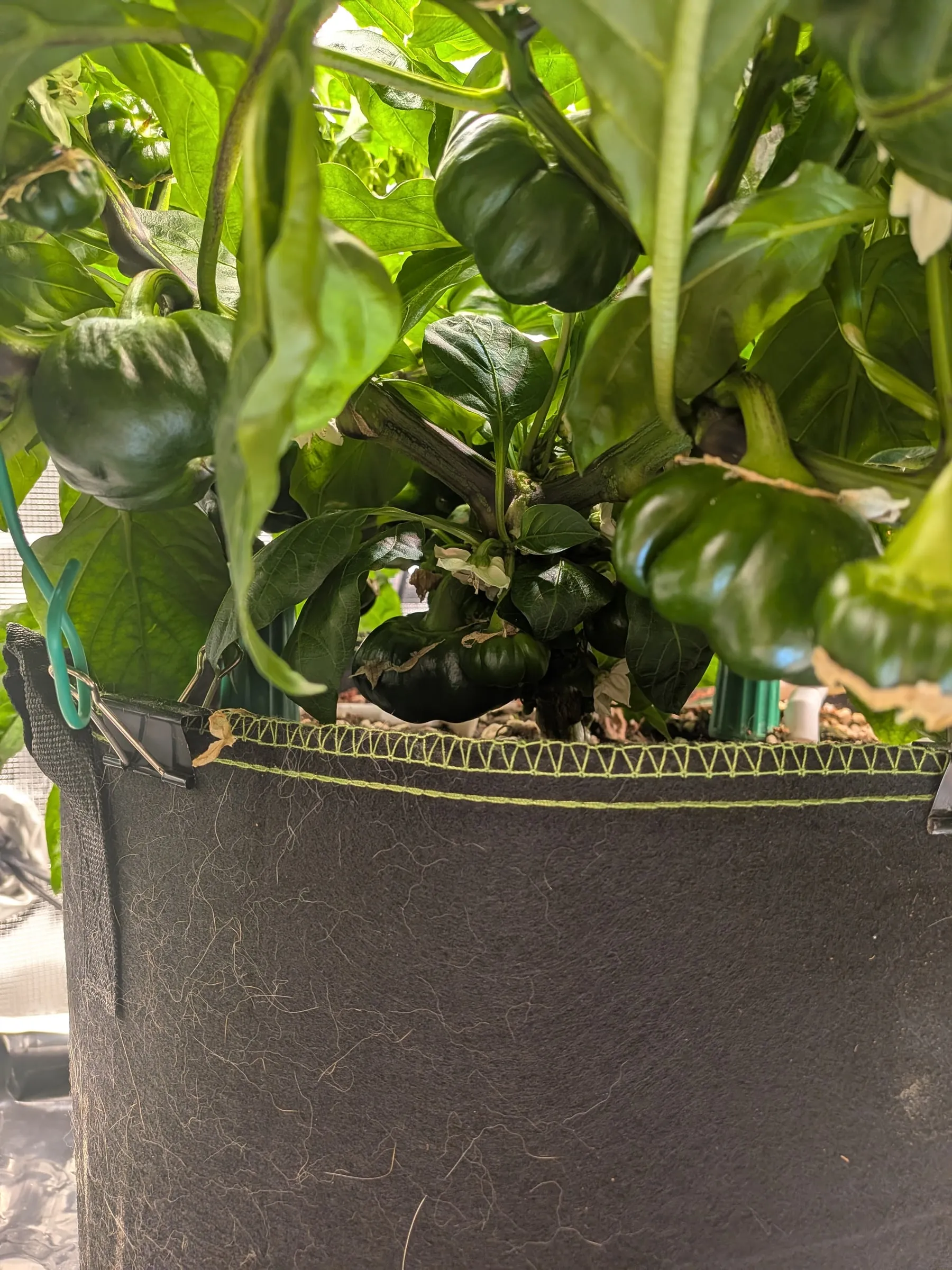
2 September — under the canopy, fruit filling in
The feed
I am deliberately feeding light, around 2 mS/cm, rather than pushing toward the top of the range below. Overfeeding is hard to walk back once the root zone has taken on salt, and a slightly hungry plant recovers faster than an overfed one. Same reasoning as the light.
Literature targets
These are the numbers I was aiming at, in ppm at the dripper, with EC in mS/cm added over source water.
| Seedling | Early Veg | Late Veg | Fruiting | |
|---|---|---|---|---|
| EC | 1.2–1.6 | 1.6–2.0 | 2.0–2.4 | 2.4–2.8 |
| pH | 5.8 | 5.8 | 5.8–6.0 | 5.8–6.1 |
| N | 80–120 | 150–190 | 170–210 | 160–200 |
| P | 25–40 | 30–50 | 35–55 | 35–55 |
| K | 90–130 | 180–240 | 220–280 | 260–340 |
| Ca | 110–150 | 150–200 | 170–230 | 190–280 |
| Mg | 30–40 | 40–50 | 45–55 | 45–60 |
| S | 30–50 | 40–60 | 45–65 | 50–70 |
| Ca:Mg | ~3.5:1 | ~4:1 | ~4:1 | 4:1 |
| NPK ratio | 1 : 0.35 : 1.1 | 1 : 0.2 : 1.3 | 1 : 0.2 : 1.4 | 1 : 0.2 : 1.6 |
N peaks in veg and is held flat or trimmed at fruiting, P stays low and nearly flat throughout, and K roughly triples from seedling to fruiting. That K climb is what pulls the ratio from about 1:1 N:K up to 1:1.6.
What I actually run
General Hydroponics Flora trio plus CaliMagic:
| Product | Analysis | Also supplies |
|---|---|---|
| FloraMicro | 5‑0‑1 | 5% Ca, Fe and micros |
| FloraGro | 2‑1‑6 | 0.5% Mg |
| FloraBloom | 0‑5‑4 | 1.5% Mg, 1% S |
| CaliMagic | 1‑0‑0 | 5% Ca, 1.5% Mg, 0.1% Fe DTPA |
Source water: 112 µS, pH 8.0. Effectively soft, near RO. Two consequences. The tap contributes no meaningful Ca or Mg, so every bit of calcium comes out of a bottle. And alkalinity is very low, so there is almost no pH buffering — a small dose of pH Down moves it a long way, and it can drift after mixing. I mix 0.2 points acidic and the solution drifts up reliably.
Dose table
Millilitres per US gallon. Divide by 3.785 for mL/L. EC totals include the 112 µS tap.
| Stage | Micro | Gro | Bloom | CaliMagic | N‑P‑K / Ca‑Mg (ppm) | Ca:Mg | EC total |
|---|---|---|---|---|---|---|---|
| Seedling | 2.0 | 2.25 | 1.75 | 2.5 | 57‑15‑60 / 73‑24 | 3.1 | ~1.1 |
| Early Veg | 3.25 | 4.5 | 2.0 | 4.0 | 97‑20‑102 / 118‑35 | 3.3 | ~1.7 |
| Late Veg | 4.0 | 5.0 | 2.25 | 5.5 | 118‑23‑115 / 154‑44 | 3.5 | ~2.0 |
| Fruiting | 4.25 | 5.0 | 2.25 | 5.5 | 122‑23‑115 / 159‑44 | 3.6 | ~2.1 |
These are calibrated with a combo pH and EC meter. An earlier version of the chart assumed 380 ppm per mS/cm; a real mix read 1700 µS where that predicted about 1000, so the true factor for this product set is nearer 242 and the original doses were about 1.6× too strong.
Bleach goes in the reservoir as well, to keep microbial growth down — about 0.5 mL per gallon for maintenance, targeting 1–3 ppm, and more than that for a shock treatment. It has had no effect on the plant that I can see, even at the higher doses.
Why additional CaliMagic
Peppers are notoriously Ca hungry, and without enough they are prone to blossom end rot. Coco also holds on to calcium and other 2+ ions tightly, reducing availability until all binding sites are saturated. For these reasons, calcium supplementation is not optional. Adding 5.5 mL/Gal of CaliMagic raises the EC by only a few tenths of a mS/cm.
Ca:Mg sits at 3.5–3.6:1 against a 4:1 ideal, slightly Mg-rich. That is inherent to CaliMagic’s 5:1.5 ratio when it is the main calcium source.
Known trade-offs
K is modest, about 115 ppm against a 260–340 target at fruiting. FloraGro is the potassium workhorse but carries 2% N, so chasing K drags N up with it, and the calibrated EC ceiling caps how far the base can go. Plants carrying a full fruit load at this feed look healthy and deep green, so I am treating 115 as adequate rather than deficient.
P is low, about 23 ppm, and that is fine. Peppers use very little of it. Raising FloraBloom to fix it would spike P and antagonize Fe and Zn uptake without meaningfully adding K.
What I would do differently
Prep the coco properly. It was reused from a previous grow and I did not prepare it well enough for a seedling, which cost a few weeks at the start while pH and EC found their level. That was the single biggest delay in the run, and it was avoidable.
This is not my first grow in this tent, so everything else is fairly dialed in at this point.
If the fruit come in thin-walled I may need to add potassium as potassium sulfate, which is clean K and S with no N and no P. That is a bridge to cross when I get to it.